
LEADERSHIP DEVELOPMENT
Integrating character, strategy, and competency into a unified leadership framework.
By Edwin Miller | Executive Chairman, TheGreyMatter.ai
| THE LEADERSHIP SERIES Part 1: The Five Marks of a Great Leader Part 2: The Strategic Mind: Long-Term Thinking Part 3: The Acquisition Discipline Part 4: The Four Levels of Conflict Part 5: The Complete Leader ← You are here |
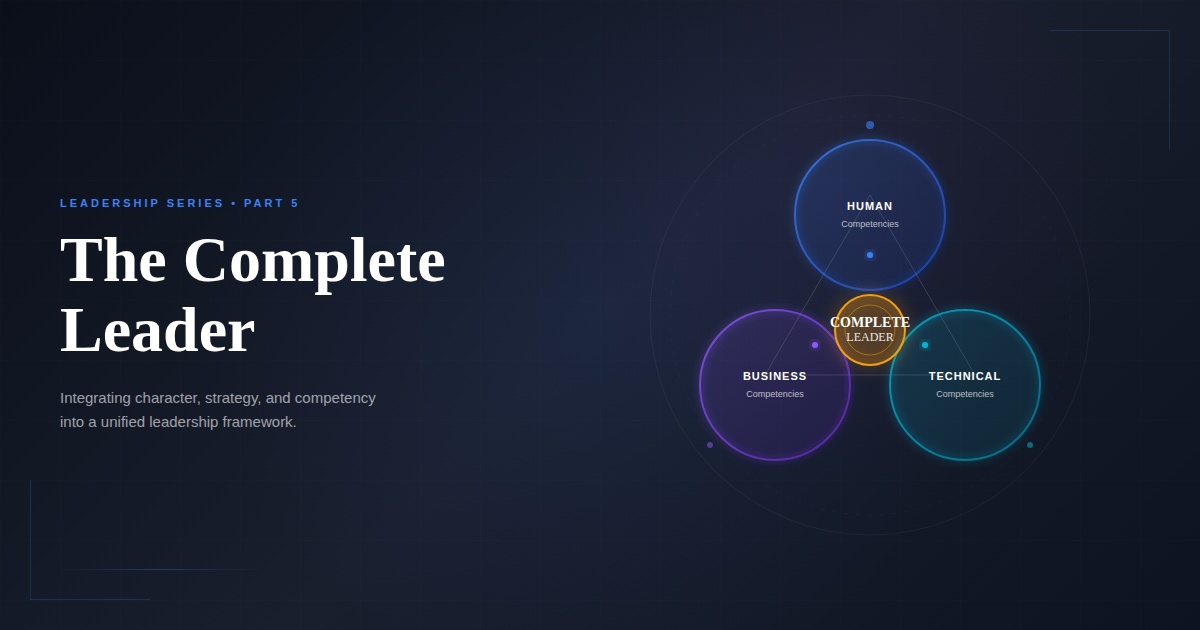
Character and strategy must be supported by competency. Drawing from a leadership competency framework I’ve refined over many years, the complete leader operates across three interconnected domains. Weakness in any domain creates vulnerability.
The Three Competency Domains
Human Competencies
Human competencies form the foundation—leadership style flexibility, communication, negotiation, team building, and the ability to empower others. These are the competencies that determine whether people follow you voluntarily or merely comply.
Business Competencies
Business competencies translate human leadership into organizational results—planning, customer orientation, and the formal education that provides frameworks for complex decision-making.
Technical/Professional Competencies
Technical/professional competencies provide the domain expertise that earns credibility. Leaders don’t need to be the smartest technical person in the room, but they must understand enough to ask the right questions and recognize excellent answers.
Applying These Principles: The 9Vectors Approach
These leadership frameworks aren’t merely philosophical constructs—they inform how we diagnose and transform organizations. At TheGreyMatter.ai, we’ve operationalized these principles into a systematic methodology:
| 9Vectors.ai | 9 vectors, 37 sub-lenses, 242+ diagnostic themes for comprehensive business assessment |
| Measurement13.ai | 13 leadership attributes with 9Box framework for continuous improvement |
| Snapshot9.ai | Financial modeling with Touch-Volume-Margin framework and scenario planning |
The Leader’s Challenge
Every leader faces a choice: address surface problems with surface solutions or dig to root causes and build lasting change. Johnson’s five marks provide the character foundation. Strategic principles from Bezos and Chambers offer the operational framework. Herring’s four levels of conflict provide the diagnostic lens. And integrated competencies ensure execution capability.
As I’ve learned across multiple CEO tenures, transformation isn’t about heroic individual action—it’s about systematically building organizations where excellence becomes self-perpetuating. The principles never change; their application evolves with each new challenge.
| The question isn’t whether these principles work. History has proven they do. The question is whether we have the courage to apply them consistently, the judgment to adapt them wisely, and the patience to let them compound over time. |
| SERIES CONCLUSION: Great leadership can be studied, understood, and systematically developed. These principles aren’t secrets accessible only to the naturally gifted—they’re learnable disciplines that separate transformational leaders from those who merely occupy corner offices. |
| Ready to transform your organization? Discover how TheGreyMatter.ai operationalizes these principles with 37+ agentic AI agents. thegreymatter.ai |
About the Author
Edwin Miller is Executive Chairman of TheGreyMatter.ai Corporation and a multi-exit CEO with experience leading startups, PE-backed companies, and public corporations. He is a YPO member, holds an MBA from George Washington University, and was recognized as one of the Top 25 Tech CEOs of Seattle for 2025.