
How Jeff Bezos built Amazon by planting seeds and waiting years for them to grow.
By Edwin Miller | Executive Chairman, TheGreyMatter.ai
| THE LEADERSHIP SERIES Part 1: The Five Marks of a Great Leader Part 2: The Strategic Mind: Long-Term Thinking ← You are here Part 3: The Acquisition Discipline Part 4: The Four Levels of Conflict Part 5: The Complete Leader |
While character marks like courage and judgment form the foundation of great leadership, strategic leadership requires additional disciplines—particularly in how we think about time horizons and customer relationships. Few executives have articulated these principles more clearly than Jeff Bezos.
The Institutional Yes
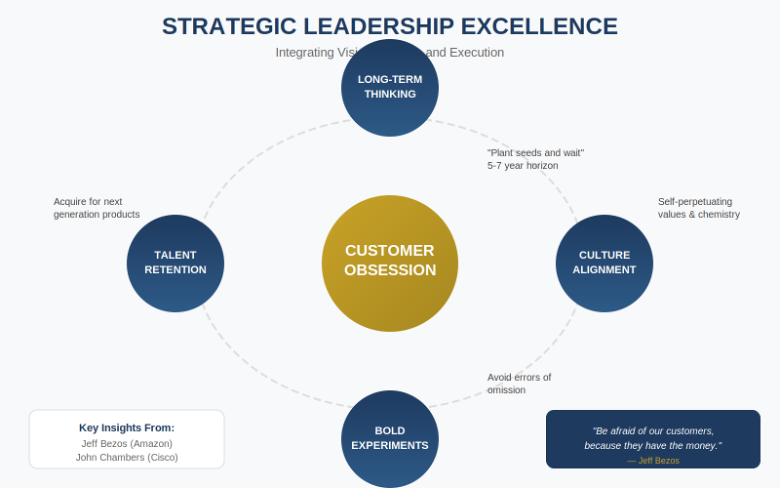
In a 2007 Harvard Business Review interview conducted by Julia Kirby and Thomas A. Stewart, Amazon founder Jeff Bezos articulated a foundational principle: be willing to plant seeds and wait for them to grow.
| “When we plant a seed, it tends to take five to seven years before it has a meaningful impact on the economics of the company.” — Jeff Bezos |
This patient capital approach stands in stark contrast to the short-termism that plagues most organizations. The key insight is what Bezos calls the “Institutional Yes”—creating a culture where people are willing to take bold leaps rather than putting toes in the water. This requires stubborn vision combined with flexible execution. The vision doesn’t change; the tactics evolve constantly based on customer feedback and market realities.
Customer Obsession Over Competitor Focus
Perhaps Bezos’s most radical principle is prioritizing customer obsession over competitor awareness. As he told the HBR interviewers, organizations should be afraid of their customers, because those are the folks who have the money—competitors are never going to send you money.
This simple reframe transforms how organizations allocate attention and resources. The strategic advantage of customer-centricity is that customer-focused strategies work better in fast-changing environments. Competitor-focused companies must constantly react to others’ moves; customer-focused companies simply keep solving problems for the people who matter most.
| SOURCE: Kirby, Julia, and Thomas A. Stewart. “The Institutional Yes: An Interview with Jeff Bezos.” Harvard Business Review, October 2007. |
| KEY TAKEAWAY: Long-term thinking isn’t just patience—it’s a competitive advantage. When you’re willing to wait 5-7 years for returns, you can pursue opportunities that competitors focused on quarterly results will never attempt. |