
M&A Due Diligence And How AI Is Solving It
Why private equity firms are abandoning fragmented advisory models for comprehensive AI-powered assessments
The Dirty Secret of Deal Diligence
Every Managing Director in private equity knows the feeling: you’ve spent $500K+ on a patchwork of advisors—Big Four accountants for Quality of Earnings, boutique consultants for commercial diligence, law firms for legal review, and IT specialists for tech assessments—only to receive twelve separate reports that don’t talk to each other.
The integration complexity? Buried in a footnote on page 47 of one report, contradicted by an assumption on page 23 of another.
The management retention risk that kills 40% of deals post-close? Mentioned in passing during a single 30-minute call.
We’re spending more than ever on due diligence while missing what matters most.
The traditional model was built for a different era—one where data was scarce, AI didn’t exist, and deals moved slowly enough to absorb 60-90 day diligence timelines. That era is over.
Why Fragmentation Fails
In my experience leading transformations at public companies (including turning around a NASDAQ company from years of losses to its first profitable year in a decade), I’ve seen both sides of M&A transactions. The problem isn’t that advisors lack expertise. The problem is structural:
1. Vector Blindness
Each advisor optimizes for their slice. Accountants dive deep into EBITDA adjustments but miss the operational reality behind the numbers. Consultants build beautiful market models without understanding the financial constraints. Legal identifies risks without quantifying integration impact.
2. Requires A Common Framework
Without a unified assessment methodology, findings can’t be compared, weighted, or synthesized. Is a customer concentration issue more critical than a key-man risk? The answer depends on context that no single advisor has.
3. Time Compression
Competitive deal processes demand speed. When you’re racing to LOI against three other bidders, waiting 45 days for fragmented reports isn’t a strategy—it’s surrender.
4. Cost Opacity
That $500K-$1M+ in advisory fees? Most firms can’t tell you the ROI. Did the diligence actually prevent bad deals, or did it just create expensive paper trails?
Introducing a New Paradigm: DueDiligence9.ai
After two decades of developing business assessment frameworks—including the methodology behind my acquisition by a global services firm and the transformation playbook that drove double-digit margin improvements—I built DueDiligence9.ai to solve this problem at its root.
The core insight: Every business, regardless of industry or scale, can be comprehensively assessed across nine fundamental vectors. These aren’t arbitrary categories—they’re the structural elements that determine whether an acquisition creates or destroys value.
The 9 Vectors of Due Diligence
How It Works: AI-Powered Comprehensive Assessment
DueDiligence9.ai isn’t a replacement for expert judgment—it’s an amplifier that ensures nothing falls through the cracks while dramatically compressing timelines.
Phase 1: Data Room Ingestion (Hours, Not Days)
Our AI systematically processes every document in your data room, automatically categorizing content across all nine vectors. Financial statements, customer contracts, employee rosters, legal filings, operational metrics—all parsed and cross-referenced.
Phase 2: Quality of Earnings Analysis
Automated EBITDA bridge construction with AI-identified adjustments. The system flags unusual items, calculates normalized earnings, and identifies potential “aggressive accounting” patterns that warrant deeper investigation.
Phase 3: Management Assessment (Powered by Measurement13)
Integration with our Measurement13 leadership evaluation framework assesses the target’s management team across 13 critical attributes. Who stays? Who’s at risk? What’s the true organizational health below the surface?
Phase 4: Integration Complexity Scoring
Unlike traditional diligence that treats integration as an afterthought, DueDiligence9.ai quantifies integration complexity from day one. Technology stack compatibility, process alignment, culture clash probability—all scored and weighted.
Phase 5: Investment Memo Generation
The output isn’t twelve separate reports. It’s a single, comprehensive investment memo structured for Investment Committee consumption, with clear recommendations, quantified risks, and supporting evidence hyperlinked to source documents.
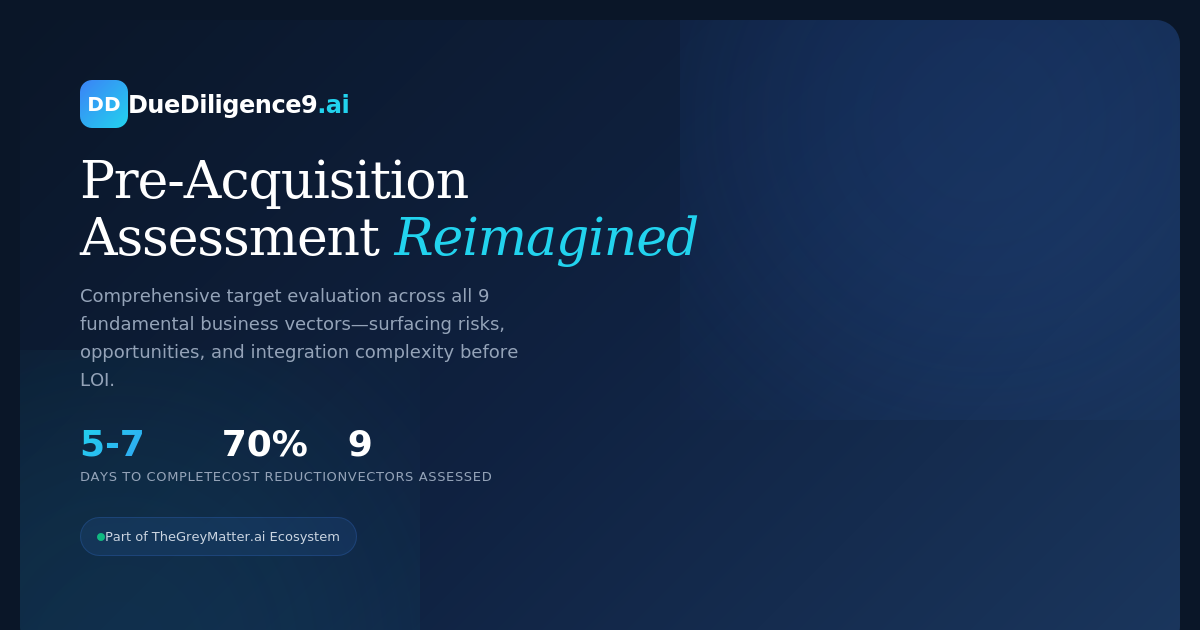
The Numbers That Matter
Who This Is For
DueDiligence9.ai was built for sophisticated acquirers who understand that speed and comprehensiveness aren’t tradeoffs—they’re table stakes in today’s competitive deal environment:
- Private Equity Deal Teams racing to deploy committed capital
- Corporate Development Groups evaluating strategic acquisitions
- Investment Banks advising on sell-side preparation
- Family Offices making direct investments without large internal teams
- Search Fund Operators conducting ETA due diligence
Part of a Larger Ecosystem
DueDiligence9.ai is one application within TheGreyMatter.ai platform—a comprehensive business intelligence ecosystem built on the 9 Vectors framework:
- 9Vectors.ai — Comprehensive business assessment across all vectors
- Measurement13.ai — Leadership evaluation and development
- Snapshot9.ai — Financial modeling with Touch-Volume-Margin methodology
- Forecast9.ai — AI-powered financial projections
- DueDiligence9.ai — Pre-acquisition target assessment
Each application shares a common data model, enabling insights to flow across your entire investment and operating lifecycle.
The Future of Deal Diligence
The M&A advisory industry is ripe for transformation. The firms that embrace AI-powered comprehensive assessment will gain structural advantages: faster deployment, better deal selection, and superior post-close outcomes.
The firms that cling to fragmented advisory models will find themselves increasingly disadvantaged – paying more, waiting longer, and missing what matters.
The question isn’t whether AI will transform due diligence. It’s whether you’ll be leading that transformation or reacting to it.
About the Author
Edwin A. Miller is Executive Chairman of TheGreyMatter.ai and creator of the 9 Vectors framework. A multi-exit CEO with experience across startups, PE-backed companies, and public markets (NASDAQ), he has led transformations that delivered first-time profitability and double-digit margin improvements.
Ready to transform your due diligence process?
Contact us at sales@thegreymatter.ai or visit thegreymatter.ai
© 2025 TheGreyMatter.ai Corporation. All rights reserved.