
Why 70% of strategies fail at execution, and why the answer isn’t another dashboard
By Edwin A. Miller | Executive Chairman, TheGreyMatter.ai
Every CEO has lived this moment: the board-approved strategy is clear. The OKRs are cascaded. The town hall went great. And six months later, you’re staring at a quarterly review wondering how things went sideways.
The strategy wasn’t wrong. The execution broke down. And here’s what no one tells you — it broke down in the gap between what you measure and how you actually perform.
The Invisible Gap That Kills Execution
Most organizations treat measurement and performance as the same thing. They’re not. They’re two fundamentally different dimensions of execution, and the distance between them is where strategies go to die.
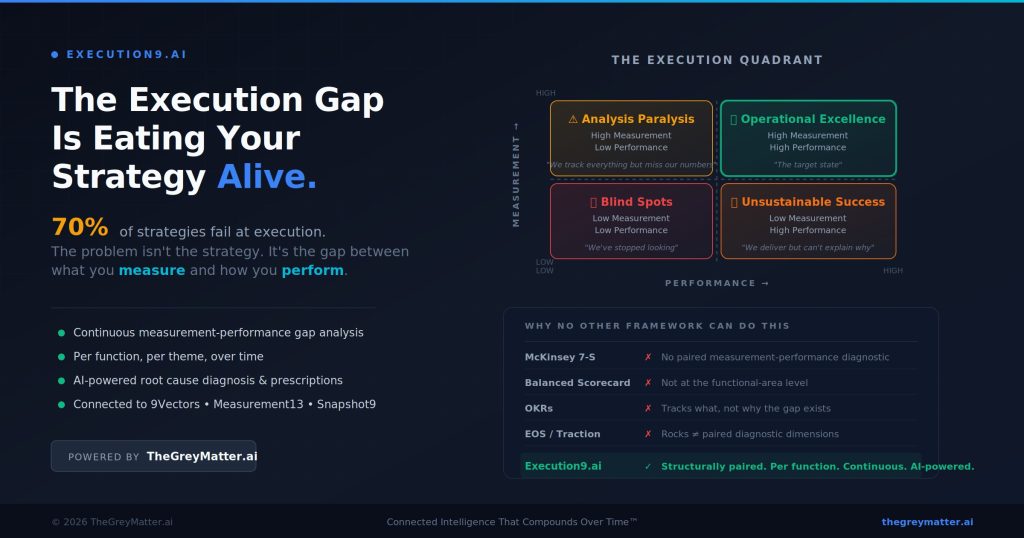
Consider this: a company might have world-class KPI dashboards tracking every metric imaginable across sales, operations, and product — yet consistently miss their numbers. That’s not a performance problem. That’s an execution gap — the organization measures everything but executes on almost nothing.
Now consider the opposite: a division that consistently delivers exceptional results, but leadership can’t explain why it works. No one has codified the process. No measurement framework captures what’s actually driving the outcomes. That’s Unsustainable Success — and it’s a ticking time bomb, because the moment a key leader leaves, the magic evaporates.
Then there are the Blind Spots — the functional areas where organizations have stopped measuring and stopped performing. These are the places no one looks at, no one asks about, and no one owns. They don’t show up in any dashboard because no one built the dashboard.
The Execution Quadrant
The gap between Measurement and Performance scores, per function, places every area of your business into one of four quadrants:
Why No Other Framework Surfaces This
This isn’t an academic exercise. This is the structural flaw in every execution framework on the market:
McKinsey’s 7-S treats systems and strategy as separate, non-paired elements. There’s no inherent mechanism to diagnose the gap between measurement rigor and execution quality within the same function.
The Balanced Scorecard connects financial outcomes to operational drivers — but it doesn’t do measurement-performance gap analysis at the functional-area level. It tells you what to measure. It doesn’t tell you whether your measurement discipline matches your execution reality.
OKRs track objectives versus key results, but they don’t diagnose why the gap exists. When an OKR comes in at 60% achievement, OKRs don’t tell you whether the problem was poor measurement design, poor execution, misaligned expectations, or all three.
EOS/Traction gives you rocks and scorecards. Useful tools. But they aren’t structured as paired diagnostic dimensions that reveal the nature of execution breakdown.
This is why we built Execution9.ai.
Execution9.ai: Diagnosing Why Execution Breaks Down
Execution9.ai is built on the 9Vectors diagnostic framework — a proprietary ontology of 9 Vectors, 37 Sub-Vectors, and 242+ diagnostic themes that maps the complete anatomy of business health. Within that framework, the Execution Vector is architecturally unique: it’s the only Vector that contains exactly two Sub-Vectors — Measurement and Performance — that form an inherent diagnostic pair.
Every functional area in your organization — sales, product, operations, finance, HR, engineering — gets assessed on both dimensions. Measurement captures how well the organization tracks, benchmarks, and makes data-driven decisions in that function. Performance captures how well the organization actually executes, delivers, and achieves goals in that same function.
The gap between those two scores, per function, per theme, over time — that’s the execution gap. And the quadrant it falls into tells you exactly what kind of execution problem you’re dealing with — and what to do about it.
Connected Intelligence That Compounds Over Time
Execution9.ai doesn’t operate in isolation. It’s one application within TheGreyMatter.ai platform ecosystem — connected to 9Vectors.ai (comprehensive business assessment), Measurement13.ai (leadership assessment), and Snapshot9.ai (financial modeling).
When Execution9.ai detects that your marketing function has a widening measurement-performance gap, it doesn’t just flag the gap. It correlates that gap with leadership assessment data from Measurement13.ai to see if the marketing leader’s diagnostic profile predicts the pattern. It pulls strategic alignment scores from 9Vectors.ai to see if the function is aligned with overall company direction. It connects to Snapshot9.ai to quantify the financial impact of the execution breakdown.
That’s not a dashboard. That’s an institutional brain that gets smarter every assessment cycle.
What This Means for CEOs, Operating Partners, and Board Members
If you’re leading a transformation — whether post-acquisition, turnaround, or growth-stage scaling — Execution9.ai gives you something no consulting engagement or project management tool can provide:
- Continuous diagnostic visibility into where execution is breaking down and why, not just whether milestones are on track.
- Prescriptive intelligence that doesn’t just report problems but recommends specific interventions based on the nature of the gap.
- Institutional memory that preserves diagnostic intelligence across leadership changes, strategy pivots, and organizational restructuring.
- Board-ready execution reporting that shows the trajectory of execution health over time — not just activity metrics, but the structural alignment between measurement discipline and execution quality.
The 70% Problem Has a Solution
Seventy percent of strategies fail at execution. That number has been stubbornly persistent for decades because the tools we’ve used to manage execution — spreadsheets, project trackers, OKR platforms, consulting frameworks — were never designed to diagnose why execution breaks down. They track activity. They don’t diagnose the structural gap between what organizations measure and how they perform.
Execution9.ai was built to solve exactly that problem. It’s the only AI-powered platform with measurement-performance gap analysis structurally embedded in its architecture — because it’s built on the only diagnostic framework where that pairing is an inherent design element, not a bolted-on feature.
ABOUT THE AUTHOR
Edwin A. Miller is Executive Chairman of TheGreyMatter.ai, Special Advisor to the Chairman at Marchex (NASDAQ: MCHX), and a multi-exit CEO with a track record of transformation across public companies, PE-backed firms, and venture-backed startups. He holds a U.S. patent for automated analytics ingestion technology and was recently recognized as one of the Top 25 Tech CEOs of Seattle for 2025.
Learn more at