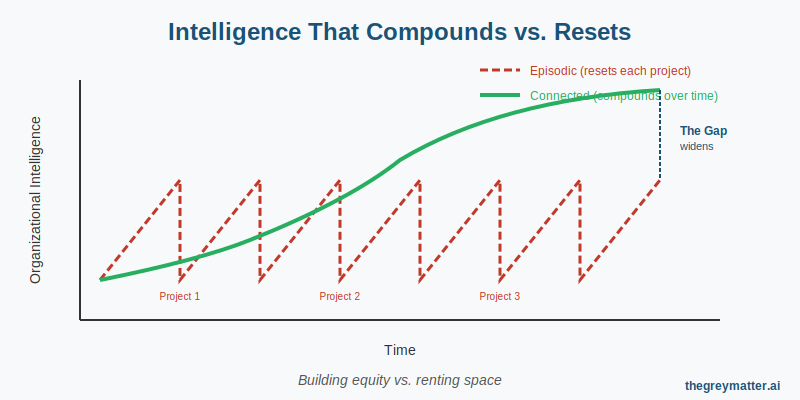

Every consulting engagement produces a deck. That deck contains valuable insights—diagnosis, recommendations, frameworks. Someone smart spent weeks developing it. Then it goes into a folder. Maybe it’s referenced once or twice. Eventually, no one can find it. The next engagement starts from scratch. This is the episodic problem with business intelligence: insights expire, knowledge fragments, memory fades. But what if intelligence compounded instead of decayed? What if every assessment, every analysis, every insight fed into a system that got smarter over time? What if a new executive could query: “What did we learn from the market expansion we tried in 2022?” and get an instant, complete answer?
This is what connected intelligence looks like:
• New information builds on old information
• Context is preserved, not lost
• Patterns emerge across time periods and business areas
• Institutional memory becomes an asset, not an artifact
The organization that compounds its intelligence has an expanding advantage. The one that resets with each project has a permanent handicap. It’s the difference between building equity and renting space.
Where does your organization’s intelligence live—in connected systems or in fragmented files?